Too often, the news inquiry begins, “An inflatable device has blown away in the wind. ” This post addresses the most common background information requested or needed to answer the questions asked.
How common are mishaps with inflatable devices?
Analysing US Consumer Product Safety Commission data, I found a large proportion of emergency department visits that involved “amusement devices” identified inflatable devices (using an impressive thesaurus-full of synonyms). However, none of the reports in that dataset involved inflatable devices that blew away in the wind.
That said, it is difficult to imagine an event in which an inflatable has blown away being recorded in a government database and NOT captured in news reports. This type of event is so remarkable that it will be in the news every time. An inflatable device blowing away in the wind is a rare event. Being rare does not mean it is impossible. It means the hazards that cause it are usually mitigated. While it is rare, it requires no imagination to know that this type of event happens. Fatalities associated with high winds and unsecured / inadequately secured inflatables happen every year.
How can operators avoid inflatables blowing away?
International standard ASTM F2374-22 requires manufacturers of inflatable devices to do fairly sophisticated analysis to determine the allowable operating conditions and provide the necessary anchor points for the device. Based on the analysis, the manufacturer supplies the device with tethers or fastening points for tethers all around the device. Each tether is an anchor point that must be secured to the ground with a stake of a certain size or a sandbag of a certain weight placed as prescribed in the device documentation.
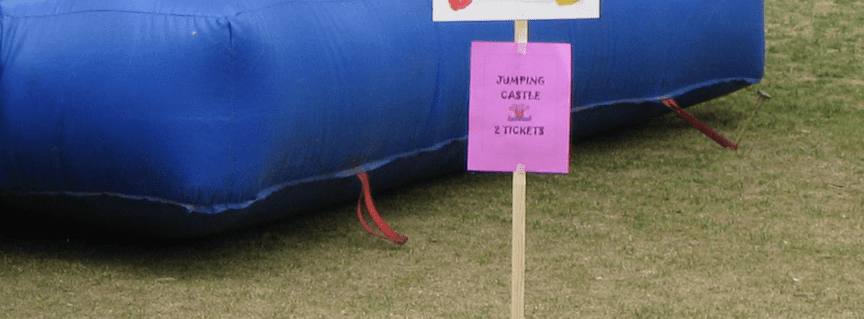
Every tether on the device must be secured. It is not proper to secure more than one tether to the same stake or sandbag unless this is explicitly directed in the manufacturer’s manual, or to substitute different stakes or underweight sandbags. Unfortunately, inadequate anchoring is not uncommon. Unfortunately, the inadequately anchored device functions as expected, with no negative feedback to convey the hazard – right up until the wind suddenly changes. Then, it becomes a matter of life and death, even if the windspeed is within the operational limits specified by the manufacturer.
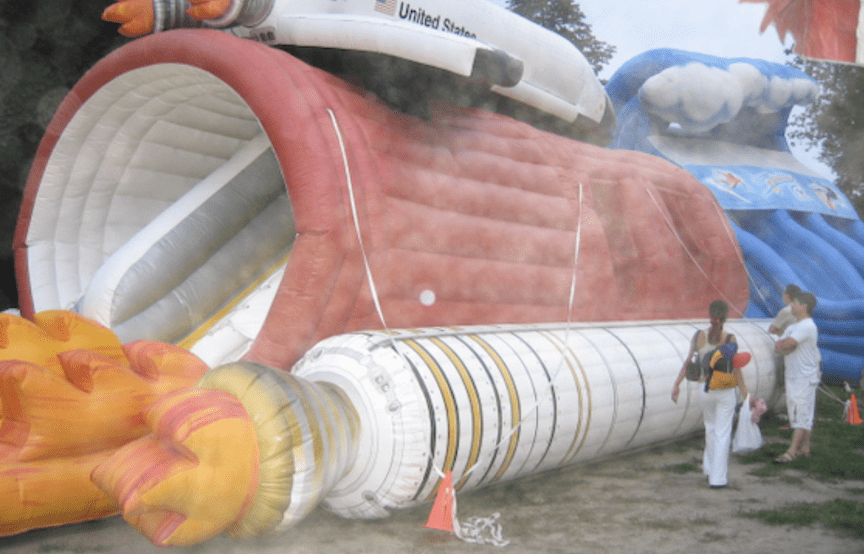
Conversely, even a properly anchored inflatable can be lifted by winds that exceed the allowable operating conditions. Protecting the device from excessive wind is not a matter of checking the weather in the morning. Theme parks monitor weather continuously and pause operation when necessary based on the operating limits of each device. While a theme park has more resources than a community long-weekend funfair, small operators and events can use weather monitoring and alerting services or portable windspeed measurement devices.
How can consumers avoid inflatables in risky conditions?
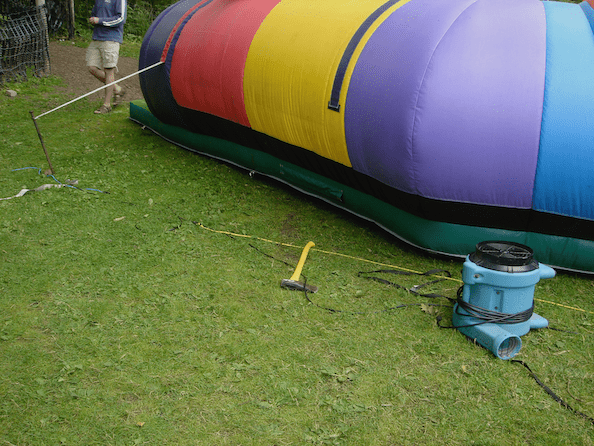
Most inflatables are used by children who are too young to make their own risk assessment. The children attend the event with adults looking out for their safety. There are hazards those adults cannot assess, such as whether a stake is the correct size or a sandbag is the correct weight or stake or sandbag is in the correct position. However, as the above photos show, it can be easy for a prudent adult to see if there are unsecured tethers or if two or more tethers share a single stake or sandbag.
Observant adults can also take note of the behaviour of flags, streamers, and balloons and even smoke from picnic grills. Weather reports or forecasts of strong gusting wind should not be discounted based on unremarkable flag behaviour, but any flags, balloons, or smoke blowing horizontally, even intermittently, is reason enough to keep children away from the device and also avoid being in its path if wind did abruptly pick up.
Consumer vigilance can be essential if the inflatables are not supervised by experienced operators. It is common for organizers of short-term events to contract with a company that is properly registered in the jurisdiction and permitted to rent their devices to events. The rental provider will set up the device, provide instructions, and pick it up later. Their contract does not include supervision of the device during the event. It may seem that volunteer attendants will be sufficient, but supervision of an inflatable device is not simply babysitting or ticket-taking. The ability to recognize and intercept hazards, including changes to the weather, comes from experience.
Another rare but serious hazard is unintended deflation. If the blower motor was to fail or become detached from the device, users on top of a device like an inflatable slide would fall. Users inside an enclosed device could be trapped. While inflated, an inflatable device looks light, but the material is very heavy and particularly small children would find it difficult to lift the material to escape without assistance. A volunteer attendant may not recognize the indications of deflation or know what they need to do.
If device malfunction is rare, how are inflatable device injuries common?
The majority of recorded injuries involving inflatables involved no malfunction of the device. Users in the inflatable sustain bumps, bruises, and fractures in impacts with one another: collisions between heads, a finger in the eye, falling and landing with limbs in a bad position or being jumped on by another user. Devices involving elevation, such as inflatable slides, include the risk of losing balance and falling before being prepared to slide, or being pushed by another user, or being struck by someone sliding down when trying to enter through the exit and climb up the slope, contrary to the rules.
Some recorded injuries from this type of event involved intoxicated young adults with diminished coordination and judgement, falling from or within the device. With much higher weight and strength than the children intended generally expected to use the device, young adults can sustain severe injury on impact and falling.
What does an experienced operator do?
Experience enables an operator to recognize hazardous behaviour before injuries occur. The operator will separate large and small children into separate groups to use the inflatable consecutively. Bigger children are more rambunctious and heavier, and mixed sizes puts the small children at risk.
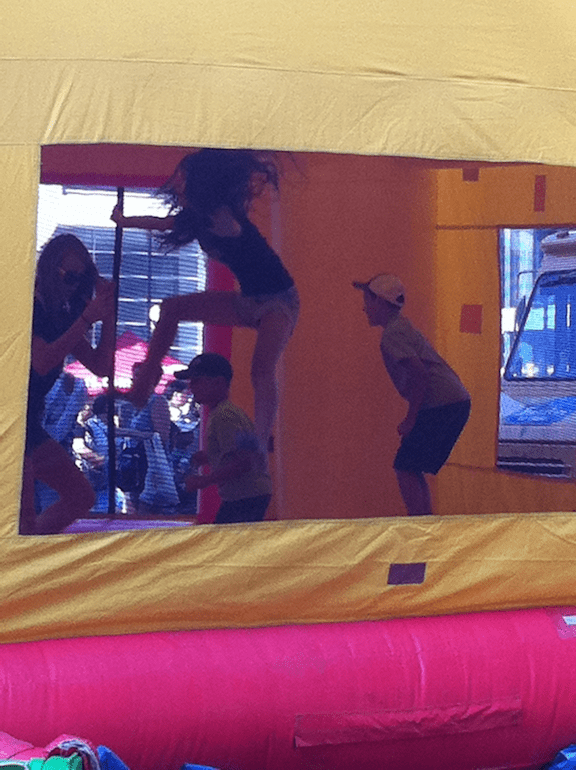
Experience enables an operator to know how many users are too many. There may be situations when the manufacturer’s allowed maximum capacity is too many users. If there are too many users, the operator cannot see them all or control their behaviour. Unlike a mechanical ride, the operator cannot turn it off if a hazard is suspected. The only intervention the inflatable operator has is to shout at the users. It may be difficult to stop non-compliant behaviour once it begins.
Volunteer attendants from a community group are more likely to see hazardous behaviour as “kids being kids”, and not appreciate the hazard. Event participants may see them simply as peers with no authority. Volunteers may also have multiple responsibilities including representing the organization and interacting with parents of children using the inflatable, which can distract them from watching the children inside. In the video below, the wind is picking up and there is no adult supervision of any kind. Professional operators have one role and can prioritize that role.
Do inflatable device malfunctions and other injuries mean that government oversight is inadequate?
If inflatables are not regulated in a particular jurisdiction, consumers would be better protected by adoption of regulations. Standards address the known hazards, and are under continuous review to consider emerging hazards and incorporate necessary revisions. However, the requirements of a standard are only obligatory if a law or regulation in the jurisdiction requires compliance with the standard. An authority must be designated to enforce compliance.
Because many hazards of inflatable devices require operational management, a regulator is very limited to assure the safety of inflatables through periodic inspection of the device because the majority of hazards are mitigated by operation. Responsible owners are motivated not just to serve their clients safely but to maintain good standing with the regulator. With a large number of inflatables in use in many jurisdictions, and many inflatables operated for just a few hours at each event, it would be prohibitively costly to have regulatory inspectors check their set-up at each event. Regulators may make site visits for operational spot-checks, to follow-up on reported injuries, or in response to consumer concerns, like the multiple hazards depicted below. A high priority for regulators is locating and penalizing operators of unregistered devices that have had no regulatory oversight at all.
The hazard in the back yard
Some inflatable injuries and fatalities have involved personally owned, non-commercial inflatables. These are excluded from the standard and regulation. The owner’s manuals almost certainly stipulate limitations operating conditions related to anchoring and wind speed, but compliance within a person’s own home is a matter for their property and liability insurer.
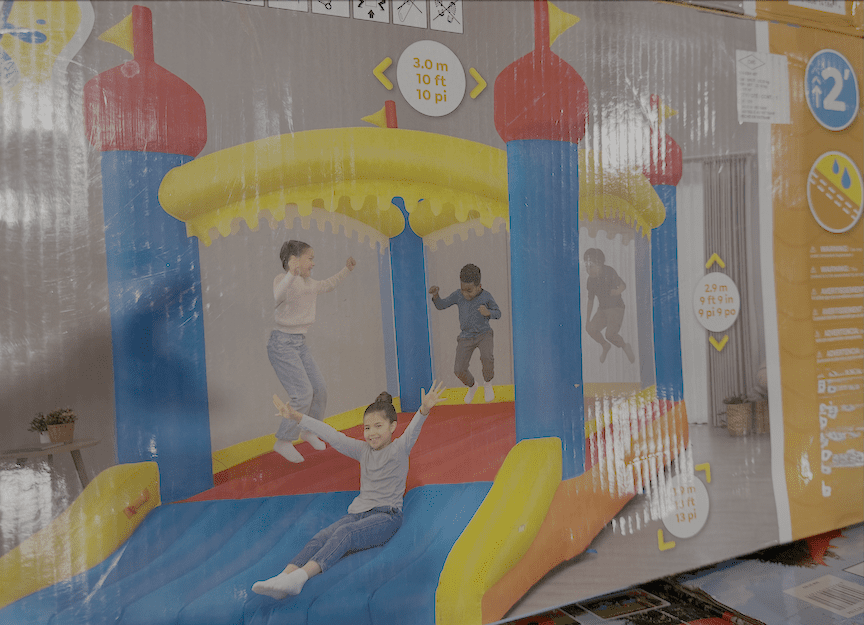
Literature and packaging accessible to consumers prior to purchase focuses on ease of setup, convenience, and durability of the device. The box has directions to avoid back injury when transporting the box, avoid damage to the device when opening the box, and directions to remove shoes. It is unclear what standards are met by the device. ASTM F2729, which applies to consumer inflatables, recommends that full compliance to the standard be made explicit in the product literature.
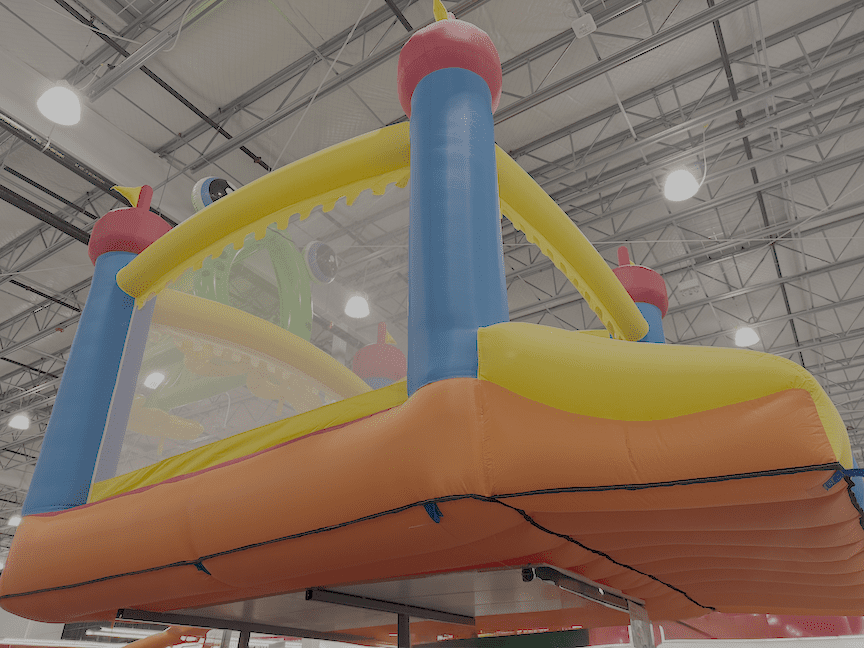
In one example product, the product is described as including the device, the air blower, and “bouncer stakes”. A catalog image shows a “bouncer stake” held daintily in the fingertips pointing at the ground through an anchor loop. This implies anchoring the stake in the ground, but does not illustrate the required depth of anchoring. It would be easy to perceive the function of the stakes as being for tidiness rather than the vital function of preventing the device becoming airborne. If the soil resists insertion of the stake, will the user understand how important it is to fully insert the stake? Will they insert each and every stake?
The supplied “bouncer stakes” appear to be plastic about 1/2″ core diameter, with sawtooth longitudinal ribs, resulting in about 3/4″ maximum diameter, and about 8″ from the point of the stake to the bottom of the anchor loop hook that remains above the soil.
When anchored using stakes, ASTM F2374 requires commercial inflatables to use stakes at least 1″ diameter (25.4mm) and at least 18″ long. A counterpart European standard EN14960 accepts 16mm diameter, at least 380mm long (15″). The holding force of a stake depends on the length of stake in the soil, diameter of the stake, and angle of insertion. According to ASTM 2374-22 §X6.2, a 5/8″ stake has only 40% of the holding power as 1″ stake the same length. A stake with 10″ in the soil has only 1/3 the holding power as a stake with 16″ in the soil. The object is to attain 163kg (360 lb) holding force per anchor point to resist maximum winds of 24 mph. The consumer inflatable standard also refers to 360 lb force for each anchor point, so smaller stakes are not the result of lower holding force requirement for lighter duty devices.
All of this must be managed by the consumer themselves, as there is no regulatory oversight of the operation of consumer inflatables. Putting this information in a paper document in the box does not protect the children in the inflatable: if a device looks ridiculously obvious how it is set up, it is common not to read a document.
How many injuries occur in Canada? Is there a national reporting system?
In Canada, constitutionally, the regulation of amusement devices is a provincial prerogative. Each province and territory determines what is regulated and what that entails, including reporting. Simply tallying the reports from all of the jurisdictions would not be a national picture. Whether an event was included in the national total would depend on where it occurred, and whether the province or territory regulates that type of device and requires reporting of that type of accident. For example, in Ontario, although an inflatable climbing device has many failure modes in common with inflatable slides, it is explicitly exempt from oversight. No registration, no legal requirement for insurance, no government inspection, no obligation to report malfunctions or injuries. Safety relies on the professionalism of the owner/operator and knowledgeable client expectations for the owner to have appropriate insurance. The insurer should impose some conditions on the coverage.
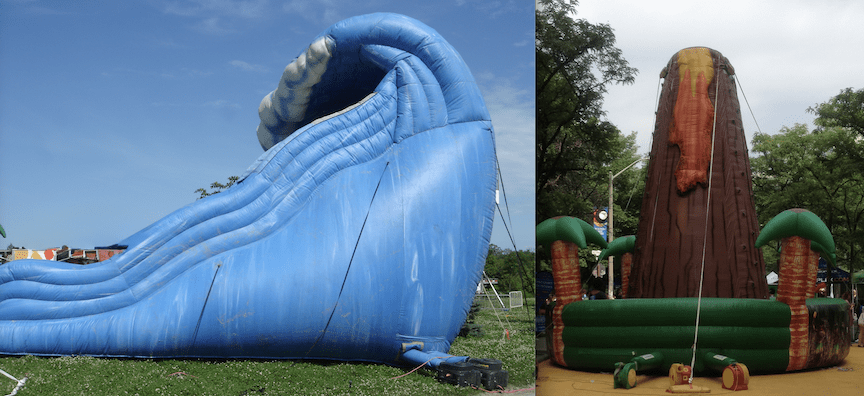
Within a province, the overall total is just the overall total. It is not representative of the risk of injury for any specific kind of accident or specific kind of amusement device. Differences in the way devices work and how riders interact with them make a significant difference to the risk of injury.
Another limitation is that the raw tallies are raw tallies. Merely counting occurrences does not reflect differences in the amount of exposure (number of rides in operation, number of hours of operation).
For rare events, the characteristics of the accident itself are more informative than quantitative data reflecting unrelated failure modes. Careful, accurate, and detailed reporting about individual events adds great value to public understanding.
