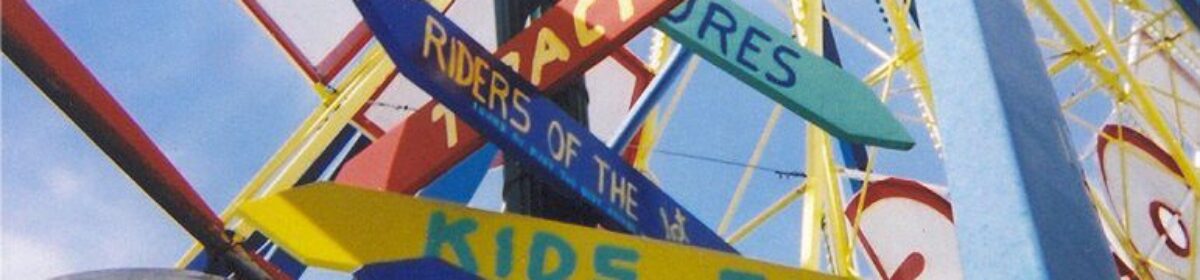
A court in Greece has reportedly sentenced owners and liable personnel over a fatal injury in August 2024. The owner of a Halkidiki amusement park was sentenced to life in prison, with his co-owner/wife sentenced to 9 years for complicity, the certifying engineer to 13 years, and the ride operator to 6 years.
This post revisits an earlier topic of piecemeal reporting on ride accidents, and the impact on the general public who do not have time to scour the internet, laws, regulations, standards, and ride catalogs for more information.
This report does not meet the standard of a minimal report as a standalone report. Specifically, the nature of the event and the ride involved are not clear to the reader.
When and where did the event happen? 👍 (Date, time, specific business or event and location) It is clear when the event occurred and the story describes “a Halkidiki amusement park” and the court hearing the case as “in northern Greece”, which is helpful for international readers.
What ride was involved? 👎 As usual 🙄, the photo used as key art in the story depicts a vertical wheel, which is not a “Crazy Dance” which is named in the report. The report stated that the event involved “a fairground ride”, which then raises questions of whether the event was at an amusement park (permanent installation) or fairground (mobile installation).
The report called the ride “Crazy Dance”, but also quoted the prosecutor’s description as a “homemade structure built without specifications or safety standards and heavily corroded”.
Since Crazy Dance is commercially manufactured by Fabbri Group, now marketed as Magic Dance, the use of the Crazy Dance name alongside descriptions as “homemade” leaves the reader unclear if this the accident involved a counterfeit that simply exploits the commercial name and resembles its ride action, or if the report is implying that the original ride had been so substantially altered over its life that it was no longer as-built. Without a photograph in this report, it is difficult to discern the intended interpretation. There is a great deal of information describing the ride in the previous reports that should have appeared here, or at least been linked to allow the reader to catch up.
Nature of the event. 👎 This report stated that the ride was “dangerously defective and poorly maintained” and there was “lack of maintenance, inadequate operator training and insufficient safety measures” resulting in “dangerous exposure”, but this report does not spell out what actually happened to produce the fatal injury to one passenger and slight injury to their companion mentioned in this report. Previous reports had made it clear that there was catastrophic failure of the attachment of the seat to the ride and the two occupants of the seat were injured on impact, one of whom sustained head impact. This should have been made clear in this report.
Stage of the ride cycle. 👎 The stage of operation was not stated in this report. Previous reports were clear that the ride had been in motion during the ride cycle, and this should have been stated in this report.
Casualties. 🫱 It is stated that a patron was fatally injured and their companion was slightly injured in the same event. The nature of the fatal injury is not clear in this report, although it was previously reported and therefore knowable to the reporter. It was not reported what the passenger’s head struck against to produce the head injury, however.
Although the report is an update on the case, readers may encounter this report as the first time they hear of the event. The report could recap key background or provide a link to previous reports. Important information should not simply be left out.
Previous reports
This report was cued by the culmination of a legal process. The actual event occurred almost two years prior to the report. Much of the missing information had previously been reported by the same media outlet in the immediate and near aftermath, and at the outset of the legal examination of claims.
However, it is not reasonable to expect the general public to know that more relevant information exists and to search for earlier reports to locate it. The news outlet’s reporters have access to all previous information published by the outlet to properly situate new information in context of what had previously been established, and answering previously unanswered questions. At the very least, hyperlinks to earlier reports would be needed.
When and where did the event happen? (Date, time, specific business or event and location)
The reporting repeatedly refers to the operation as an amusement park or funfair, but photographs look like mobile rides or carnival. An earlier report (2024AUG21) quoted officials stating that the park “comes every summer and gets a temporary license for two months.” This confuses the public, who should be aware of differences between permanently installed amusement devices and mobile devices.
What ride was involved? Earlier stories (2024AUG21 and 2024OCT08) did include photos of the accident ride, and referred to it variously as Crazy Dance and a “spinning chair ride”.
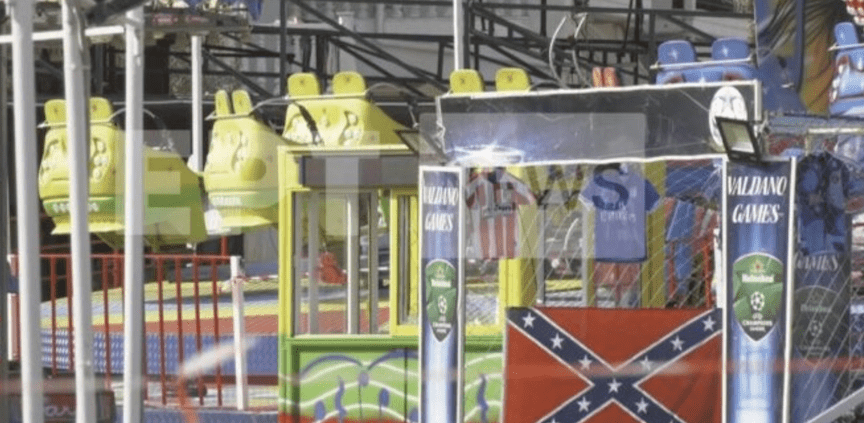
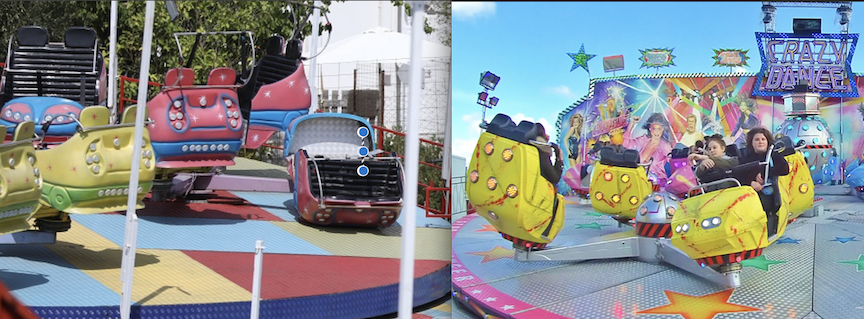
This photo shows a device that is configured similarly to a Crazy Dance but does not appear to be a Crazy Dance as made by Fabbri. Multiple differences can be seen, including the size and shape of the passenger seating unit, the orientation of the seating unit with respect to the satellite sweeps, the shape of the satellite sweeps, and the turntable height, among other things. (Ironically, the photo of this accident ride was used as key art to illustrate a completely different ride accident, as criticized in the earlier blog post.)
Nature of the event. It is clear that the fatally injured rider was outside the intended riding position at the end of the event. However, it is important to how the separation occurred. Catastrophic failure of the attachment of the seat to the ride is not the only potential cause of separation. In some cases, a rider self-extracts, or a restraint device is inadequate to retain them, or the restraint device fails. Earlier reporting (2025NOV28) included testimony of the ride speed increasing, an audible crack preceding the detachment of the seat from the ride – catastrophic (i.e., sudden, irreversible) failure. Descriptions refer to the injured passenger being “thrown”, “flung”, or “ejected”. Photographs of corrosion were released by the family of the deceased, supporting the characterization that the attachment of the seat to the ride had a catastrophic failure.
Stage of the ride cycle. It has been clear in all earlier reports that the separation of the rider from the ride occurred being during the ride cycle with the ride in motion.
Casualty. A report (2024AUG10) described the deceased being ejected and sustaining “massive injuries” and instantaneous death. Later reports (2024DEC17) refer to massive “head” injuries. The head injury would have involved impact with a structure or surface or object, at a certain distance from the intended ride path, but no reporting specific to this question was found by searching this media outlet.
Special commentary
Coverage of an event that occurred almost two years earlier typically results from culmination of a legal process, either related to charges by a regulator or civil litigation. In the immediate aftermath of an accident, standard communications guidance is to refrain from speculation and allow the investigation to be completed. We are now past this point. Facts have been tested in court. Reporting following the conclusion of legal examination should be more, not less, complete than earlier reports.
It is unclear why someone was charged or sentenced, or not charged or sentenced, unless there is an explanation of what the person was accused or found responsible for doing and what obligations existed to not do the thing, or to do a different thing.
Some readers will be satisfied to focus on the actions of a proximal person accused or found responsible – the “villains” of the story. It was reported that two investigations were being pursued beyond the accident itself, to examine the operating regime of the amusement park and the third the certifications it received to operate both this year and in previous years. This still focuses on the “villains” and fails to explore the adequacy of the systemic defences against villains.
Other readers will be conscious that “villains” may emerge at any time in any setting, and their actions might take a variety of forms. Those readers want to read what structural and procedural defences did not exist and need to be created, and what defences exist but failed.
In this case, some important defences are mechanisms of third party oversight. Amusement ride standards and regulatory inspection are common measures taken by jurisdictions around the world. Across the multiple reports, several elements of oversight were described but none of the reports examines them together and uses the information to address the question of whether the combined defences were inadequate or whether they failed, nor does the report adequately examine whether changes are needed, and if so, what kind.
It was reported (2024AUG21) that amusement devices in that specific jurisdiction require licensing, that the municipality has the sole authority to grant licenses and control compliance, and that that violations may instantiate an order to close the operation.
In the same report, the Mayor cited a lack of police resources limiting detection of unlicensed operations and claimed an inability to know when unlicensed operators would be operating. At the same time, the Mayor stated that the carnival was a regularly occurring annual operation. In many jurisdictions, regularly scheduled events are anticipated, making it simpler to notice exceptions, such as expected filings not received. While this does not catch first-time offenders, it would catch a regular operator that has failed to obtain a required license yet sets up to operate anyway.
The shortage of police resources was a moot issue, as it was also reported (2024AUG21) the police had inspected the facility and reported to the municipality that the operator was present and had showed an engineer’s certificate but could not produce an operating licence, constituting unauthorized operation.
No intervention for the unauthorized operation – either closure or fine – is documented. Instead, the report indicated that the municipality is allowed 60 days to determine how to respond to a reported infraction. This policy is effectively no oversight and has no consequence for unlicensed operation, except for events scheduled to exceed 60 days. A 60-day period only protects the public if a device is prohibited from operating until the municipality affirmatively determines otherwise.
In the wake of the fatality, the agency that provided the safety certification was stripped of its authorization to issue certifications, and all rides certified by the same agency were directed to close pending certification by another engineer. However, while the news outlet described these operations as “shut down”, it did not report on any independent observation as to whether those operations actually did shut down. It is possible that they were simply told to close and did not, given the 60-day delay in municipal enforcement.
It does not take away from the responsibility determined by the court to observe that the regulatory system was inadequate. Penalizing the responsible individuals in this case will not prevent other accidents. That will require improvement of the system of regulatory oversight.
The ride’s previous owner reportedly testified that she had sold the ride to the current owner in 2020 for scrap. After seeing the catastrophic failure in the news, she volunteered the testimony, as it was evident that the new owner had done makeshift repairs to operate the device instead. While some used rides are sold across borders and the history of the transaction is difficult for the new jurisdiction to access, the previous owner of this device was also within Greece. It could have been possible to mark the device as scrapped to prevent it from being passed off as serviceable. In many jurisdictions, regulators will examine both the design and the service history of a used ride being registered to a new owner. Those procedures could have prevented this device from being put into service.
Another observation that was reported and not further explored was that a local prosecutor declined to order a technical investigation of the accident ride. While an appeals court prosecutor had ordered one, it is difficult to understand how a catastrophic device failure could occur and the evidence not be seized for examination. This is a grave systemic vulnerability and reinforces the lack of effective oversight. Even if technical examination of the evidence in this case had revealed nothing beyond what was immediately apparent to the unsophisticated observer, there will be events where that is not the case. When an event involves a previously unidentified failure mode, the technical investigation is an essential process to ensure that failure mode will be properly accounted for in the future. The public should be concerned if the entities established to protect them are not taking every reasonable measure to identify and intercept threats to public safety and preventable injury.
The media can be a critical component to educate and equip the public to determine their expectations of the public safety oversight system. Piecemeal and incomplete media reports cannot fulfill this potential.
This report
Life sentence for amusement park owner over fatal accident 2026JUN13
Earlier reports
Amusement parks under scrutiny 2024AUG21
Police informed municipality that deadly amusement park ride had no license 2024AUG21
Inspector calls fun park ride that caused teenager’s death ‘extremely dangerous’ 2024AUG23
Fatal amusement park ride was destined for scrap 2024AUG26
Opinion: a funfair state 2024AUG27
Prosecutor orders technical inspection of fatal funfair ride 2024AUG30
Three charged in Halkidiki fun park death 2024OCT08
Fatal amusement park accident trial opens 2025NOV28
Dozens of playgrounds, amusement parks being shut down amid safety concerns 2024DEC05
Amusement park owners and operator to testify over fatal August accident 2024DEC17
Amusement park owner remanded over fatal August accident 2024DEC17
New probe into funpark death 2025JUN05
